Your Week-by-Week Pregnancy Guide: What to Expect From Conception to Birth
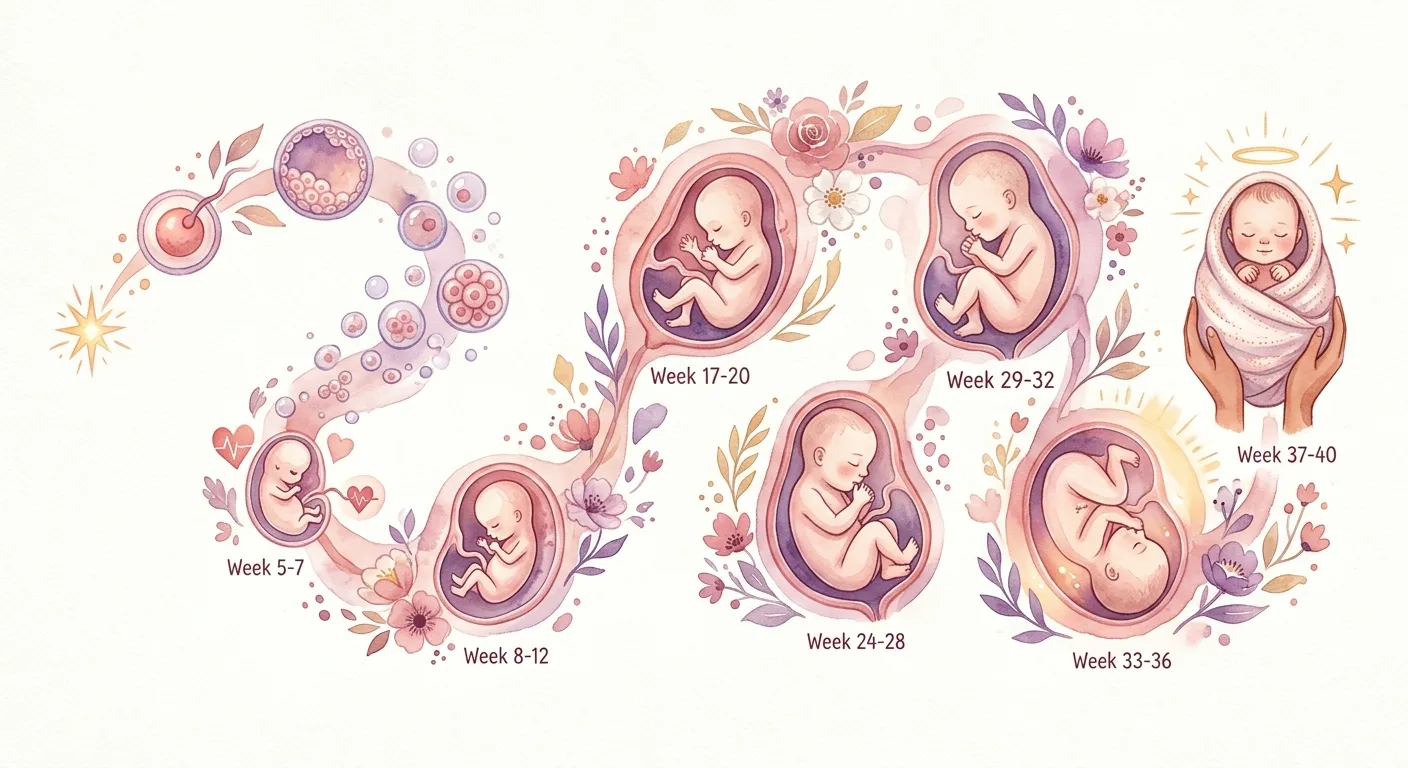
A full-term pregnancy spans 40 weeks from the last menstrual period — roughly 38 weeks of actual fetal development. Here’s what the research shows is happening at each stage, what symptoms are expected versus concerning, and which calculators on this site are most useful when.
How Pregnancy Weeks Are Counted
Gestational age is measured from the first day of the last menstrual period (LMP), not from conception. This creates a counterintuitive numbering: at the 2-week mark on the gestational calendar, most people haven’t conceived yet. Conception typically occurs around day 14 in a standard 28-day cycle.
Use the due date calculator to establish your gestational age from LMP, or from conception date if you know it. The tool calculates using Naegele’s rule (LMP + 280 days), the clinical standard, with adjustments for cycle length variations.
First Trimester (Weeks 1–12)
Weeks 1–4: Conception and Implantation
Ovulation typically occurs at week 2. Fertilization, if it occurs, happens in the fallopian tube within 24 hours of ovulation. The fertilized egg takes 6–12 days to travel to the uterus and implant in the endometrial lining — typically around days 20–24 of the cycle, or gestational weeks 3–4.
Implantation bleeding — light spotting lasting 1–2 days — occurs in approximately 25% of pregnancies and is often mistaken for a light period. A home pregnancy test can detect hCG (human chorionic gonadotropin) reliably from the date of the expected period onward, or approximately gestational week 4.
Weeks 5–6: Early Embryonic Development
The embryo is approximately 1–5 mm. The neural tube — which will become the brain and spinal cord — forms during weeks 3–4 post-conception (gestational weeks 5–6). This is why folate supplementation must begin before conception: neural tube closure is complete before most people know they are pregnant. The cardiac structures begin forming; a flicker of cardiac activity is detectable on transvaginal ultrasound by week 6.
Common symptoms at this stage: breast tenderness, fatigue (significant — progesterone levels are rising sharply), nausea beginning around week 6 for most people. The nausea signal is driven by hCG, which peaks at weeks 10–12; this is why nausea generally peaks and then resolves in the second trimester.
Weeks 7–10: Organogenesis
This is the period of greatest teratogenic sensitivity — the window when medications, alcohol, and other environmental exposures carry the highest risk of structural birth defects, because all major organ systems are forming simultaneously. The embryo transitions to “fetus” status at week 10 when the critical period of organogenesis is largely complete.
By week 10, the fetus is approximately 3 cm crown-to-rump. Fingers, toes, facial features, and external genitalia are forming. The heart has four chambers and beats at 150–170 bpm — nearly twice adult resting rate, which is developmentally normal and will gradually slow through gestation.
Weeks 11–12: End of First Trimester
The risk of miscarriage drops sharply after week 10. Approximately 80% of miscarriages occur in the first trimester; the rate after week 10 is approximately 1–5% for low-risk pregnancies. The nuchal translucency scan — the first-trimester anatomy screen — is typically performed at weeks 11–13.
Cell-free fetal DNA (cfDNA) screening, which analyzes fetal DNA fragments in maternal blood, is typically offered from week 10 onward. Sensitivity for trisomy 21 (Down syndrome) exceeds 99% with false-positive rates below 0.1% — superior to the older quad screen. Positive cfDNA screening results are followed by diagnostic testing (amniocentesis or CVS) for definitive diagnosis.
Second Trimester (Weeks 13–26)
Weeks 13–16: Relief and Quickening
For most people, the second trimester brings significant symptom relief — nausea typically resolves by week 14, energy returns, and the miscarriage risk is substantially lower. The uterus expands above the pubic symphysis and becomes palpable abdominally.
Fetal movement (quickening) is first felt between weeks 16–25. Multiparous individuals (those who have been pregnant before) often notice movement earlier — as early as week 14–16 — because they recognize the sensation. First-time parents typically feel it between weeks 18–22.
Weeks 17–20: Anatomy Scan
The anatomy ultrasound at weeks 18–22 is the most comprehensive fetal evaluation in the standard prenatal schedule. It assesses:
- Brain, spine, and facial structures
- Heart structure (four-chamber view and outflow tracts)
- Abdominal organs and diaphragm
- Limb length and bone structure
- Placental location (identifying placenta previa)
- Amniotic fluid volume
- Cervical length (a predictor of preterm birth risk)
Sex assignment, if desired, is typically visible at this scan. Use the due date calculator to confirm your gestational age for scheduling.
Weeks 21–26: Fetal Lung Development Begins
Lung maturation is a late-pregnancy event — surfactant production begins in earnest around week 22–24 but doesn’t reach functional levels for independent breathing until approximately week 34–36. This is why premature birth at 28–32 weeks typically requires respiratory support even with otherwise intact development.
At week 22, survival with intensive NICU care is possible but outcomes vary significantly by hospital. At week 24, survival rates reach 50–70% with appropriate care. Every week of gestation after 22 materially improves lung function and survival probability.
The glucose challenge test (GCT) for gestational diabetes is scheduled at weeks 24–28. Approximately 6–9% of pregnancies develop gestational diabetes; rates are higher in those with BMI over 30, family history of diabetes, or prior GDM diagnosis.
Third Trimester (Weeks 27–40)
Weeks 27–30: Rapid Growth Phase
The fetus gains approximately half its birth weight between weeks 27 and 40. At week 27, average fetal weight is approximately 900g; at term (40 weeks), average birth weight is 3,400g (7.5 lbs). This growth requires significant caloric and nutritional support — iron requirements double in the third trimester as fetal iron stores build.
Fetal movement should be well-established by week 28. Standard clinical guidance from ACOG recommends tracking fetal movement from week 28 onward. The kick counter tool on this site tracks movements and timestamps them. Most guidelines consider 10 movements within a 2-hour window reassuring.
Weeks 31–36: Positioning and Final Organ Maturation
Most fetuses are vertex (head-down) by week 32–36. Breech presentation after week 36 is present in approximately 3–4% of term pregnancies. An external cephalic version (ECV) — manual attempt to turn the baby — can be attempted at weeks 36–37 with approximately 60% success rate.
Lung surfactant production reaches functional levels around week 34–36, which is why “late preterm” infants (34–36 weeks) typically require only brief respiratory support. Brain myelination — the insulation of nerve fibers that enables rapid neural transmission — continues through term and into the first year after birth.
Track your weight gain trajectory against IOM guidelines using the pregnancy weight gain calculator. The third trimester accounts for approximately half of total gestational weight gain.
Weeks 37–40: Full Term
ACOG revised the definition of “full term” in 2013 to distinguish:
- Early term: 37 0/7 through 38 6/7 weeks
- Full term: 39 0/7 through 40 6/7 weeks
- Late term: 41 0/7 through 41 6/7 weeks
- Post-term: 42 weeks and beyond
Outcomes are measurably better at 39–40 weeks than 37–38 weeks; elective delivery before 39 weeks without medical indication is not recommended. Most guidelines offer induction of labor at 41 weeks due to increasing placental insufficiency risk post-term.
Warning Signs to Know at Every Stage
Contact your provider immediately for any of the following, regardless of gestational age:
- Vaginal bleeding (any amount in second or third trimester)
- Severe abdominal pain or cramping
- Symptoms of preeclampsia: severe headache, visual changes, upper right abdominal pain, facial or hand swelling
- Decreased fetal movement after week 28 (fewer than 10 movements in 2 hours)
- Signs of preterm labor before 37 weeks: regular contractions more than 4 per hour, pelvic pressure, watery discharge
- Symptoms of ruptured membranes: a gush or steady trickle of fluid
The contraction timer tracks contraction frequency, duration, and interval — the three measurements your provider will ask about if you call reporting contractions.
Frequently Asked Questions
Calculate Your Due Date
Get your estimated due date, current gestational week, and trimester timeline using clinically accurate Naegele’s rule. Free, instant, no sign-up required.
Open Due Date Calculator →