Pregnancy Week by Week: Key Milestones, Symptoms & What to Expect
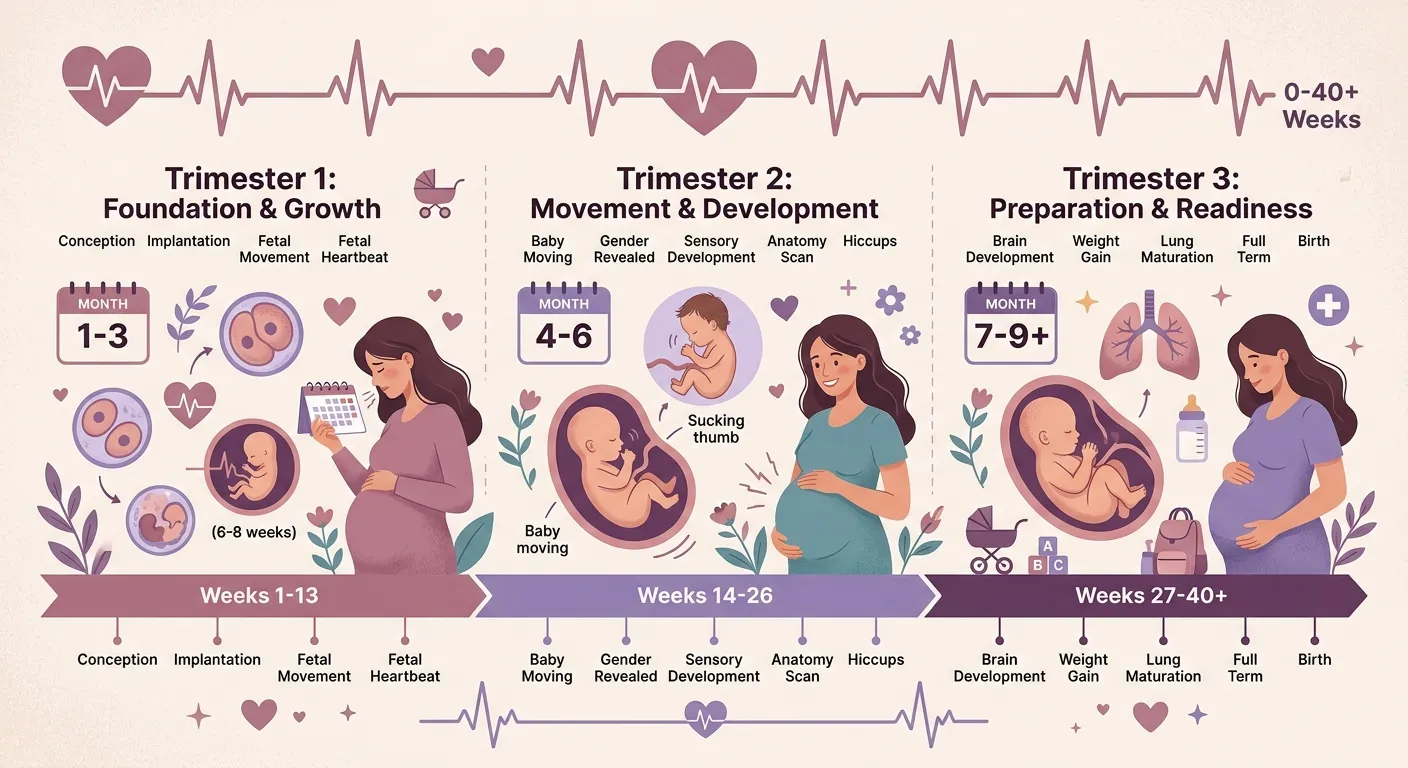
Pregnancy is 40 weeks, divided into three trimesters. Most people know the trimesters. Fewer know what is actually happening biologically at each stage — or what symptoms are normal vs. what warrants a call to your provider.
Here is what the research and clinical guidelines actually say, week by week.
Before you read, know your dates: use the NestCalc due date calculator to confirm your current gestational week and estimated due date — this article makes more sense when you know where you are.
First Trimester: Weeks 1–13
The first trimester is the period of most rapid and critical development. The embryo forms all major organ systems during these 13 weeks. It is also the trimester with the highest miscarriage risk — approximately 80% of all pregnancy losses occur in the first trimester (ACOG, 2015).
Weeks 1–4: Conception and Implantation
Gestational age is counted from the first day of your last menstrual period (LMP), not from conception. This means weeks 1 and 2 predate conception entirely — they represent the follicular phase of your cycle.
Conception typically occurs in week 3. The fertilized egg (zygote) travels down the fallopian tube, dividing rapidly, and reaches the uterus by days 5–6 post-fertilization. Implantation — the attachment of the blastocyst to the uterine lining — occurs between days 6 and 12 post-fertilization (roughly gestational week 3–4).
What you may notice: Implantation bleeding (light spotting, often pink or brown) affects roughly 25% of women — it is normal and does not indicate miscarriage. A missed period. Early pregnancy tests become positive as early as day 10 post-fertilization due to rising hCG levels.
Weeks 5–8: The Embryonic Period
This is the most critical developmental window. Between weeks 5 and 10, all major organ systems form: the neural tube (precursor to the brain and spinal cord) closes by day 28 post-fertilization — this is why folic acid must be taken before conception and in early pregnancy. The heart begins beating around day 22 and is detectable by ultrasound by week 6–7.
| Week | Baby Size | Key Development | Common Symptoms |
|---|---|---|---|
| Week 5 | Sesame seed (2mm) | Neural tube forming; heart begins beating | Fatigue, breast tenderness, light cramping |
| Week 6 | Lentil (6mm) | Heartbeat detectable by transvaginal ultrasound; arm and leg buds forming | Nausea begins; frequent urination |
| Week 7 | Blueberry (13mm) | Brain hemispheres forming; face features developing | Morning sickness peaks; food aversions |
| Week 8 | Kidney bean (16mm) | Fingers and toes forming; organs are present | Nausea, fatigue, bloating |
Important: Organogenesis — the formation of organs — is essentially complete by week 10. Exposure to teratogens (certain medications, alcohol, infections like rubella) is most dangerous during this window because it can disrupt organ formation.
Weeks 9–12: Fetus Formation
At week 10, the embryo officially becomes a fetus — a distinction that reflects completed basic structural development. The fetus now has all organs present, though none are fully functional.
Week 11–13 is when first-trimester screening typically occurs: nuchal translucency ultrasound (measures fluid at the back of the neck to screen for chromosomal abnormalities like Down syndrome) and cell-free fetal DNA (NIPT) blood test. ACOG recommends offering aneuploidy screening to all pregnant patients, not just those over 35.
By week 12, the risk of miscarriage drops to less than 2% for confirmed pregnancies. The placenta takes over hormone production from the corpus luteum — this shift often correlates with nausea subsiding.
| Week | Baby Size | Key Development | Common Symptoms |
|---|---|---|---|
| Week 9 | Grape (23mm) | Embryo → fetus transition; facial features more distinct | Fatigue, nausea, mood changes |
| Week 10 | Kumquat (31mm) | All organs present; fingernails forming | Nausea may ease slightly |
| Week 11 | Fig (41mm) | Fetus can move, though not yet felt | Bloating, constipation common |
| Week 12 | Lime (54mm) | Reflexes developing; external genitalia forming | Nausea often improves; energy returning |
| Week 13 | Pea pod (74mm) | Unique fingerprints forming; kidneys producing urine | First trimester symptoms fading for most |
Use the trimester calculator to see exactly which trimester you are in, along with your current week and what developmental milestones apply.
Second Trimester: Weeks 14–27
The second trimester is often called the “honeymoon trimester” — nausea has usually resolved, energy returns, and the baby is developing rapidly but the physical demands of late pregnancy have not yet arrived. Miscarriage risk is now below 1%.
Weeks 14–18: Rapid Growth
The fetus more than triples in length between weeks 14 and 20 — from about 3.5 inches to nearly 10 inches. The skeletal system hardens (ossification). Lanugo — a fine, downy hair — covers the body to help regulate temperature. The fetus begins practicing breathing movements, swallowing amniotic fluid, and making facial expressions.
Between weeks 16 and 22, most women feel the first fetal movements — called quickening. First-time mothers typically feel it later (weeks 18–22) than those who have been pregnant before (weeks 16–18). What you feel: flutters, bubbles, or light tapping sensations. These are easy to miss initially.
Week 18–22: Anatomy Scan
The anatomy ultrasound at 18–20 weeks is one of the most important prenatal appointments. It evaluates all major fetal organs, checks placental position, measures amniotic fluid levels, and screens for structural abnormalities. It can also reveal fetal sex if the baby is positioned cooperatively and you want to know.
| Week | Baby Size | Key Development | What Happens |
|---|---|---|---|
| Week 16 | Avocado (4.6 in) | Facial muscles active; sucking reflex present | Quickening may begin (experienced moms) |
| Week 18 | Sweet potato (5.6 in) | Ears functioning; responds to sound | Anatomy scan window opens |
| Week 20 | Banana (6.5 in) | Swallowing amniotic fluid; vernix coating forming | Anatomy ultrasound; halfway point |
| Week 22 | Papaya (7.6 in) | Eyebrows and eyelashes forming; sleep-wake cycles | Gestational diabetes screening upcoming |
| Week 24 | Ear of corn (8.0 in) | Lung development accelerating; surfactant production begins | Viability milestone (~50% survival with NICU) |
| Week 26 | Scallion bunch (9.2 in) | Eyes can open; responds to light | Third trimester approaches; kick counts recommended |
Between weeks 24 and 28, your provider will screen for gestational diabetes with an oral glucose challenge test (OGCT). Gestational diabetes affects 6–9% of pregnancies (CDC, 2022) and has no symptoms — screening is how it is found. If you screen positive, a 3-hour glucose tolerance test (GTT) follows.
Third Trimester: Weeks 28–40+
The third trimester is defined by rapid weight gain (both yours and the baby's), organ maturation, and preparation for birth. The baby gains approximately half its total birth weight between weeks 28 and 40.
Weeks 28–32: Lung Maturation
The critical milestone in the third trimester is lung development. Surfactant — the substance that prevents alveoli from collapsing — is produced in sufficient quantities for survival by approximately week 34. Before that, prematurely born infants require surfactant supplementation in the NICU.
From week 28 onward, your provider will discuss kick counts — daily monitoring of fetal movement. The standard method: count movements after a meal until you reach 10 movements; they should arrive within 2 hours. Use the NestCalc kick counter to time and log your sessions.
Weeks 33–36: Positioning and Final Development
Most fetuses rotate to a head-down (cephalic) position between weeks 32 and 36. A fetus that remains breech after 36 weeks may require external cephalic version (ECV) or a planned cesarean section. ECV is successful in approximately 58% of cases (Hofmeyr & Kulier, Cochrane Review, 2012).
| Week | Baby Size | Key Development | Common Symptoms |
|---|---|---|---|
| Week 28 | Eggplant (10 in, 2.2 lb) | Eyelids open and close; brain developing rapidly | Backache, heartburn, leg cramps; kick counts begin |
| Week 30 | Butternut squash (10.8 in, 3 lb) | Bone marrow producing red blood cells | Shortness of breath; Braxton Hicks contractions |
| Week 32 | Jicama (11.4 in, 3.8 lb) | Toenails complete; lanugo shedding | Frequent urination; sleep difficulty |
| Week 34 | Cantaloupe (12.6 in, 4.7 lb) | Lungs nearly mature; central nervous system developed | Pelvic pressure; waddling gait |
| Week 36 | Romaine lettuce (13.4 in, 5.8 lb) | Most organ systems mature; baby gaining ~0.5 lb/week | Lightning (baby drops); easier breathing |
| Week 38 | Pumpkin (14 in, 6.8 lb) | Lanugo mostly shed; vernix thickening | Cervical effacement may begin |
| Week 40 | Small watermelon (20.2 in, 7.6 lb avg) | Full term; ready for birth | Bloody show; irregular contractions possible |
Weeks 37–40+: Term Pregnancy
ACOG revised its definitions in 2013: early term is 37–38 weeks, full term is 39–40 weeks, late term is 41 weeks, and post-term is 42+ weeks. This matters because outcomes are measurably better at 39+ weeks — elective deliveries before 39 weeks without medical indication are associated with higher NICU admission rates, respiratory problems, and feeding difficulties (Tita et al., 2009, n=13,258).
Post-term pregnancy (42+ weeks) affects approximately 3–10% of pregnancies. Most providers recommend induction by 41–42 weeks because placental function declines after 40 weeks and stillbirth risk increases modestly.
Warning Signs to Know at Every Stage
Most symptoms are normal. These are not:
| Symptom | Timing | Action |
|---|---|---|
| Heavy vaginal bleeding | Any trimester | Go to ER immediately |
| Fever above 100.4°F (38°C) | Any trimester | Call provider same day |
| Severe abdominal pain | Any trimester | Call provider or ER |
| Sudden severe headache, vision changes, rapid swelling | Second/third trimester | ER — possible preeclampsia |
| No fetal movement for 12+ hours (after 28 weeks) | Third trimester | Call provider immediately |
| Fluid leaking before 37 weeks | Any | Call provider — possible PPROM |
| Regular contractions before 37 weeks (4+/hour) | Second/third trimester | Call provider — preterm labor |
When in doubt, call. Obstetric providers would rather answer a question that turns out to be nothing than miss a call that was something.
Key Prenatal Appointments and Screenings
ACOG recommends the following visit schedule for uncomplicated singleton pregnancies: every 4 weeks through 28 weeks, every 2 weeks from 28–36 weeks, then weekly from 36 weeks until delivery. High-risk pregnancies and multiple gestations have more frequent monitoring.
| Timing | Screening/Appointment | Purpose |
|---|---|---|
| Before conception / Week 1–8 | Folic acid 400–800 mcg/day | Neural tube defect prevention |
| Weeks 10–13 | NIPT blood test; nuchal translucency ultrasound | Chromosomal screening (optional) |
| Weeks 18–20 | Anatomy ultrasound | Structural screening; sex determination |
| Weeks 24–28 | Glucose challenge test (OGCT) | Gestational diabetes screening |
| Week 28 | Rh factor check; Rhogam if Rh-negative | Prevent Rh sensitization |
| Week 28+ | Kick count monitoring daily | Fetal wellbeing surveillance |
| Week 35–37 | Group B Strep (GBS) culture | Antibiotic prophylaxis planning for labor |
| Week 36+ | Cervical checks begin; fetal position confirmed | Birth planning; breech management if needed |
Calculating Your Timeline
Two calculators are most useful during pregnancy:
- Due date calculator: Enter your last menstrual period date or conception date to get your estimated due date (EDD) and current gestational age. Uses Naegele's rule (LMP + 280 days) for LMP-based estimates, consistent with ACOG guidance.
- Trimester calculator: Shows exactly which trimester you are in, how many weeks remain in each phase, and key milestone dates — anatomy scan window, viability, full term, due date.
First-trimester ultrasound, if available, is more accurate than LMP-based dating — especially for women with irregular cycles, unknown LMP, or recent hormonal contraceptive use. If your ultrasound date differs from your LMP date by more than 7 days (in the first trimester), ACOG recommends adjusting the due date to match the ultrasound.
Frequently Asked Questions
Track Your Pregnancy Week by Week
Use NestCalc's free pregnancy calculators — due date, trimester timeline, weight gain, kick counter, and more. No sign-up required.
Calculate Your Due Date →